
In a unitary system like the Philippines, the central (national) government traditionally holds substantial control, with laws and policies “trickling down” to the local level. However, modern Philippine governance is guided by the principle of decentralization, which aims to empower local governments.
Local governments are the political subdivisions at the lowest level of an elected territorial organization. In the Philippines, these Local Government Units (LGUs) are created by the national government through legislation and are tasked with providing essential public services and implementing national welfare policies.
Decentralization, Democratization, and Governance
Decentralization is the process of transferring planning, decision-making, or administrative authority from the central government to local governments, field organizations, or non-governmental organizations. It is crucial for strengthening local participation and, therefore, enhancing democracy.
There are four major forms of decentralization:
- Deconcentration: This is the simplest form, involving the redistribution of administrative duties within the central government—for example, shifting workload from the national capital to a central agency’s regional field staff.
- Delegation to Semi-Autonomous Bodies: This involves transferring specific decision-making and management authority to bodies not directly controlled by the central government, such as public corporations or regional development authorities.
- Devolution: This is the most significant form for local governance. It involves the central government formally giving up or relinquishing certain functions, services, and regulatory powers to LGUs, strengthening their independent authority and promoting local autonomy.
- Transfer of Functions to Non-Government Institutions: This involves transferring administrative and planning powers to voluntary, private, or non-governmental institutions.
Devolution and democratization are mutually reinforcing. Decentralization requires democratic processes and enhances local participation, demanding democratic accountability and good management from the local government system.
Historical Overview of Philippine Local Government
The history of local governance in the Philippines has been a constant struggle between centralization and decentralization:
- Pre-Colonial Period: Governance was highly localized, centered on the autonomous barangay (30-100 households) ruled by a datu.
- Spanish Occupation: A highly centralized system was introduced, retaining the barrio (barangay) but creating higher tiers: pueblos (municipalities), cabildos/ayuntamientos (cities), and provincias (provinces), all ultimately controlled by the Governor-General in Manila.
- American Colonial Period: While the Americans introduced democratic principles like local elections, the politico-administrative structure remained largely centralized, reinforcing Manila as the political and economic center.
- Post-War Period (1946–1972): A trend toward decentralization emerged with key legislation like the Local Autonomy Act (RA 2264) and the Barrio Charter (RA 2370).
- Martial Law: The period under dictatorship reversed the trend, imposing a highly centralized system to consolidate power.
The Local Government Code of 1991 (RA 7160)
The shift toward greater decentralization was enshrined in the 1987 Constitution, which mandates the state to “ensure the autonomy of local government.” This constitutional provision led to the landmark Republic Act 7160, or the Local Government Code (LGC) of 1991.
The LGC brought about fundamental changes:
- Devolution of Basic Services and Facilities: Functions and responsibilities for health, agriculture, social welfare, and environmental management were transferred from national government agencies to LGUs.
- Fiscal Autonomy: LGUs were given the power to create their own revenue sources, levy taxes and charges, and receive a just share of national taxes (Internal Revenue Allotment or IRA) and proceeds from the utilization of national wealth.
- Creation of Autonomous Regions: The Constitution and subsequent laws provided for the creation of the Autonomous Region in Muslim Mindanao (ARMM, now BARMM) and the Cordillera Administrative Region (CAR).
Structure and Criteria of Local Government Units
The Philippine President exercises general supervision over all LGUs, but provinces, cities, municipalities, and barangays enjoy substantial autonomy in local affairs. The local government structure comprises several tiers:
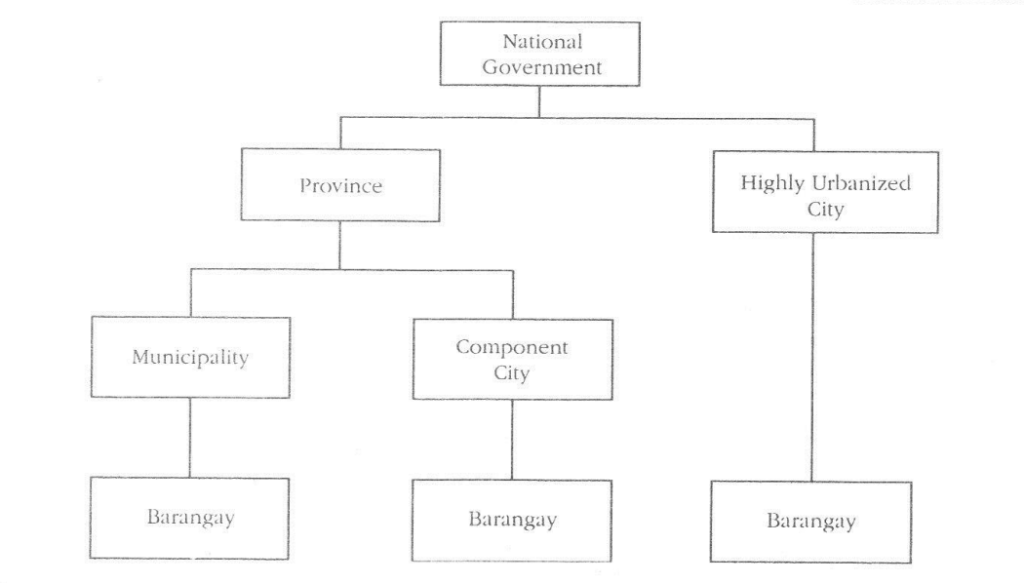
The LGC of 1991 sets specific criteria for the creation, merger, division, or abolition of LGUs, all of which require a plebiscite of the affected political units. These criteria involve minimum requirements for Income, Population, and Land Area.
| LGU | Income (Minimum) | Population (Minimum) | Land Area (Minimum) |
| Barangay | N/A | 2,000 (5,000 for Metro Manila) | N/A |
| Municipality | P2.5 million | 25,000 | 50 sq. km |
| City | P20 million | 150,000 | 100 sq. km |
| Province | P20 million | 250,000 | 2,000 sq. km |
The decentralization provided by the LGC of 1991 gave LGUs four major roles: efficient service delivery, management of the environment, economic development, and poverty alleviation.
Impacts and Challenges of Devolution
Devolution has had several important effects on Philippine politics and governance:
- Innovation: Some LGUs have become centers of innovation, implementing effective and entrepreneurial local governance programs.
- Empowerment: LGUs have generally become more assertive in pursuing their own development agendas.
- Partnerships: The transfer of functions has strengthened collaborative partnerships between LGUs and Civil Society Organizations (CSOs) or Non-Governmental Organizations (NGOs).
Despite these successes, significant challenges remain:
- Persistence of Traditional Politics: Many areas are still governed by traditional politicians (trapos) who rely on patronage and coercion, which undermines the LGC’s goal of democratization and participatory governance.
- Centralist Tendencies: Some national government officials and agencies still resist full devolution, maintaining central control over resources and decision-making.
- Inequality: There is an unequal distribution of financial and human resources, with many smaller LGUs struggling to meet the demands of their devolved functions due to insufficient training and funding.
- Accountability Issues: A lack of robust mechanisms for transparency and accountability persists in some LGUs, leading to continued failure in addressing basic constituent needs.
The future success of decentralization in the Philippines hinges on the dynamic interplay between a vibrant civil society that demands good governance, the impact of globalization on local economies, and the sustained commitment of ordinary citizens to actively participate in local affairs.
